PlatformAboutContact

The physics engine
is the product.

Most simulation tools are built experience-first: design what the user will see, then fit physics to the visuals. We build the opposite way. The physics engine is primary. Everything visible on screen is a consequence of what the engine calculates.

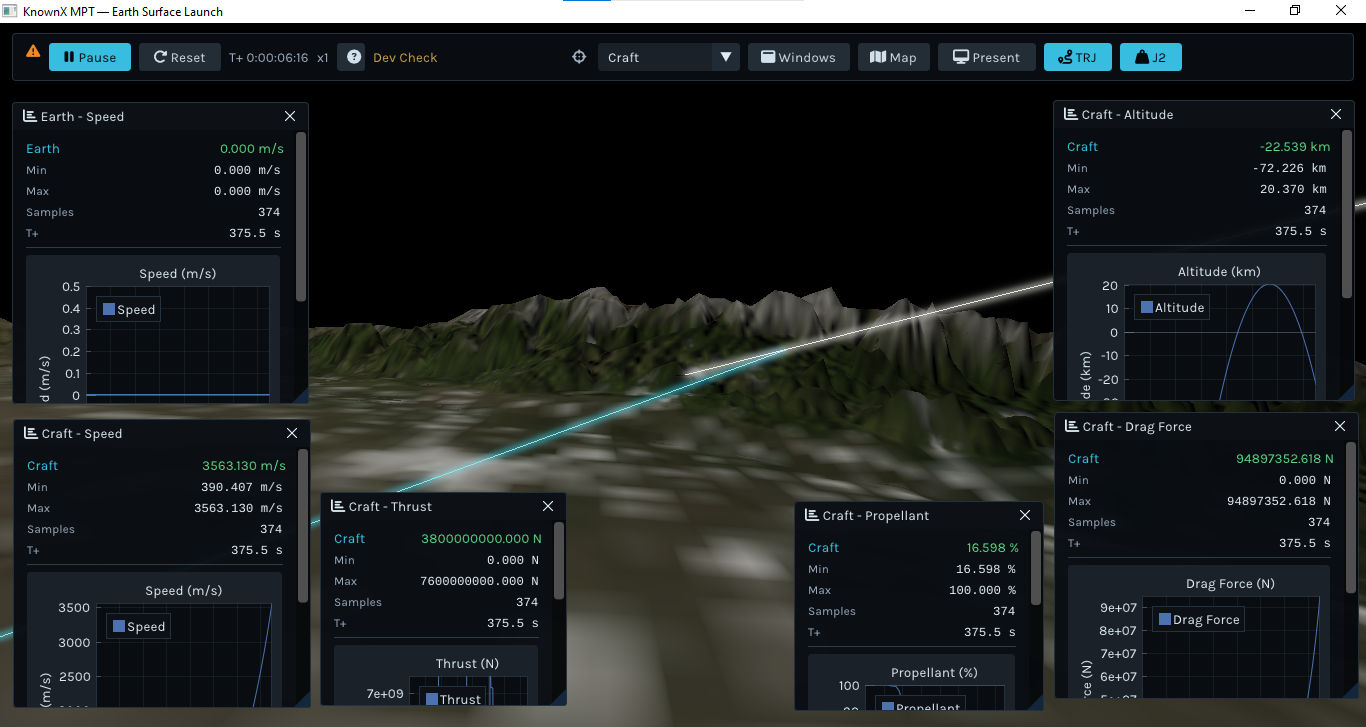
The KNOWN physics engine is written in C++ and rendered with OpenGL. The core systems below are currently in development.

Gravitational Modelling

Point-mass gravity for all bodies in the simulation. Earth J2 oblateness perturbation, the non-spherical component of Earth's gravitational field, is essential for accurate LEO simulation. Third-body gravitational effects from the Sun and Moon are part of the foundation.

Atmospheric Drag

Altitude-dependent drag modelling for low Earth orbit. Satellites in LEO experience drag that continuously decays their orbit. A simulation that ignores this is not modelling LEO.

Thrust & Manoeuvre Modelling

Finite burn models for propulsion events, delta-V manoeuvres, and propellant mass consumption over burn duration. Without thrust modelling, you cannot simulate a mission, only a passive orbit.

N-Body Architecture

No fixed centre of mass. Every body in the simulation has mass, position, and velocity. The reference frame is selectable: Earth-centred, Sun-centred, spacecraft-centred, or another context the mission requires.

Accuracy is not
a claim. It is
a test result.

Anyone can say their simulation is accurate. We verify ours against public data.

TLE data, or Two-Line Element sets, are publicly available records of real satellite orbital parameters through sources including Space-Track and CelesTrak. A satellite's documented TLE contains enough information to reproduce its trajectory mathematically.

Our validation approach: import a documented TLE into the KNOWN engine, propagate the orbit, and compare the engine output against the satellite's known position over time. If the simulation diverges from the documented trajectory, the physics is wrong. We correct the physics until it does not diverge.

A simulation that cannot reproduce a documented satellite trajectory is not a simulation. It is a visualisation.

Data references: Space-Track and CelesTrak.

Research. Arcade.
Cinematic. One engine.

Three distinct uses of the same physics system. The interface and experience differ. The calculations underneath do not.

Use 1

Research & Analysis Tool

For: Engineers, researchers, academic institutions, space agencies

A professional orbital analysis environment. Users can input real TLE or ephemeris data, propagate orbits over time, model propulsion manoeuvres, and analyse the results. The tool is designed to the accuracy standard that institutional research requires.

  • Real TLE / ephemeris data import
  • Orbit propagation with J2, drag, and thrust modelling
  • Delta-V manoeuvre planning and analysis
  • Selectable reference frames
  • Results export for further analysis
Use 2

Arcade Mode

For: Students, space enthusiasts, educators, general users

Trajectory challenges and mission scenarios grounded in real orbital mechanics: rendezvous problems, launch window timing, and gravity assist manoeuvres. The challenges are designed to be engaging without simplifying the physics.

  • Mission scenarios based on orbital mechanics principles
  • Progressive difficulty from basic concepts to complex manoeuvres
  • Score and timing systems
  • Educational context embedded in each scenario
Use 3

Cinematic Missions

For: General audience, storytelling, broader engagement

Story-driven space missions with narrative, timeline, and consequence. Designed for the experience of being in space, not the analysis of being in space, while still grounded in the same physics as everything else on the platform.

  • Narrative-driven mission structure
  • Physically accurate environments and trajectories
  • Cinematic rendering and experience design
  • Accessible to users with no prior knowledge of orbital mechanics

Built for
accuracy at scale.

Engine language C++
Rendering OpenGL
Architecture N-body, selectable reference frame
Gravity model Point-mass + J2 perturbation + third-body
Drag model Altitude-dependent atmospheric drag
Propulsion model Finite burn, delta-V, mass consumption
Validation method TLE-based trajectory comparison
Scale range Low Earth Orbit to interplanetary
Platform target Desktop: Windows, macOS, Linux

Specifications are subject to change during development. This table reflects the current design target.

Launching 2026.
Early access available
for institutions.

The first public release of the KNOWN simulation platform is targeted for 2026. We are currently offering early access registration for research institutions, universities, and aerospace organisations.

Early access participants will receive direct access before public release, the opportunity to provide feedback that shapes the final product, and direct communication with the development team.

For individual users and general access registration, use the homepage form.

Request staged.

This form will connect to the production endpoint in the backend phase.